


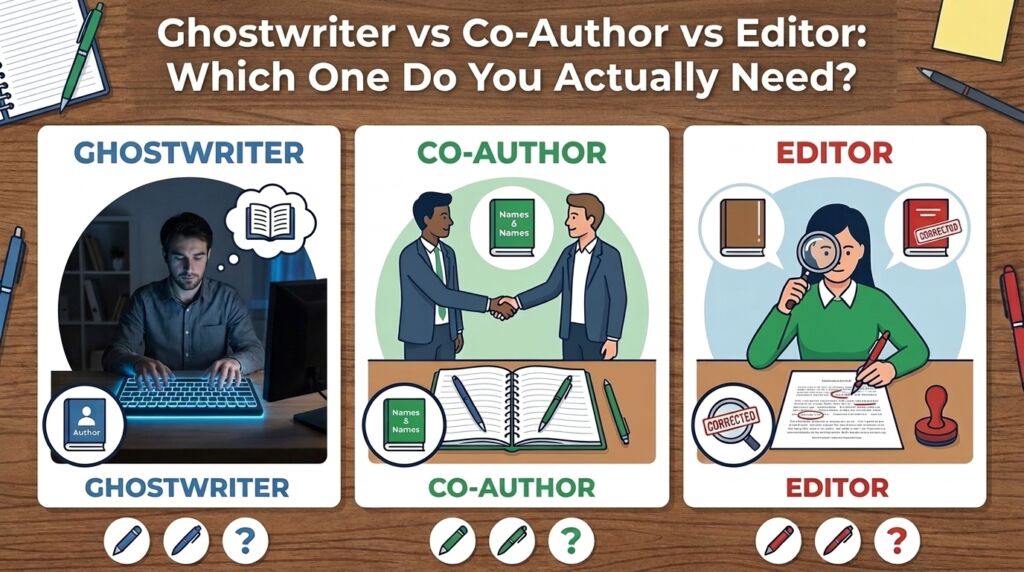
Quick Answer: Hire a ghostwriter if you have the ideas but no time or writing skill, and you want full authorship credit. Choose a co-author if you want a true writing partner who shares the byline (and often the royalties). Bring in an editor if your manuscript is already drafted and needs to be sharpened, restructured, or polished. The right choice depends on three things: how much of the book you can write yourself, whose name goes on the cover, and your budget.
Why This Decision Matters More Than You Think
Every year, thousands of first-time authors abandon their book projects. Not because the idea was weak, but because they hired the wrong kind of writing partner. A CEO looking for a ghostwriter ends up with a co-author demanding 50% of royalties. A novelist who needed a developmental editor pays a ghostwriter to rewrite chapters that only needed restructuring. A memoirist hires an editor when the manuscript doesn’t yet exist.
These are expensive, morale-crushing mistakes. And they almost always come from confusing three very different roles.
This guide breaks down exactly what each professional does, what they cost, when to hire them, and, most importantly, how to know which one your project actually needs.
What Is a Ghostwriter?
A ghostwriter writes the book for you, in your voice, based on your ideas, interviews, notes, or outlines. Your name appears on the cover as the sole author. The ghostwriter is usually contractually invisible, bound by a non-disclosure agreement and paid a flat fee that includes the transfer of all rights.
A ghostwriter typically:
- Conducts interviews to capture your voice, story, and expertise
- Researches your topic independently
- Writes the full manuscript from scratch
- Revises based on your feedback
- Signs away all authorship credit and IP rights
Typical cost: $10,000 to $100,000 or more for a full-length nonfiction book. Memoirs and business books usually fall in the $25,000 to $60,000 range for a mid-career professional ghostwriter. Celebrity ghostwriters routinely charge six figures.
Best for: Executives, thought leaders, entrepreneurs, coaches, and public figures who have valuable ideas or lived experience but lack the time, writing skill, or desire to draft 60,000 or more words themselves.
What Is a Co-Author?
A co-author writes with you, and their name appears on the cover alongside yours. This is a collaborative partnership, not a work-for-hire arrangement. Co-authors typically share royalties, split the advance (if traditionally published), and hold joint copyright.
A co-author typically:
- Contributes original writing, research, or expertise
- Shares creative decisions about structure, tone, and content
- Receives public credit as an author
- Splits royalties (commonly 50/50, but negotiable)
- Retains long-term rights to the work
Typical cost: Often no upfront fee, or a reduced fee, in exchange for a royalty share. Some co-authors charge a hybrid rate: a smaller flat fee (say, $15,000) plus 20% to 40% of royalties.
Best for: Authors who want a true creative collaborator, projects where two experts bring complementary knowledge (a doctor and a journalist, a founder and an industry analyst), and situations where sharing credit builds credibility.
What Is an Editor?
An editor works on a manuscript that already exists. They don’t write the book. They make your writing better. There are several types of editors, and confusing them is one of the most common first-time-author mistakes.
The four main editing levels:
- Developmental editor. Looks at big-picture structure, story arc, argument flow, and chapter organization. Typical cost: $0.03 to $0.08 per word ($1,800 to $4,800 for an 80,000-word book).
- Line editor. Improves sentence-level clarity, rhythm, voice, and word choice. Typical cost: $0.04 to $0.10 per word.
- Copy editor. Fixes grammar, punctuation, consistency, and style-guide adherence. Typical cost: $0.02 to $0.04 per word.
- Proofreader. Catches final typos and formatting errors before publication. Typical cost: $0.01 to $0.02 per word.
Best for: Writers who have already written a draft, even a rough one, and want to elevate it rather than start over.
Ghostwriter vs Co-Author vs Editor: Side-by-Side Comparison
| Factor | Ghostwriter | Co-Author | Editor |
|---|---|---|---|
| Who writes the book | They write it for you | You both write | You write it, they refine |
| Whose name is on the cover | Yours only | Both names | Yours only |
| Who owns the copyright | You (usually) | Shared | You |
| Typical payment structure | Flat fee | Fee plus royalties, or royalties only | Flat fee or per-word rate |
| Typical cost range | $10K to $100K+ | Variable; often royalty-based | $500 to $5,000+ per pass |
| Timeline | 6 to 12 months | 6 to 18 months | 2 to 8 weeks per editing pass |
| Best when you have | Ideas but no draft | A partner and shared vision | A completed draft |
| NDA involved | Almost always | Rarely | Sometimes |
How to Decide: A Simple Three-Question Framework
Instead of guessing, run your project through these three questions.
1. Do you have a draft, or just an idea?
- No draft, just ideas or notes: ghostwriter or co-author
- Rough or complete draft: editor
2. Do you want your name alone on the cover?
- Yes, sole credit: ghostwriter
- Willing to share credit: co-author
3. What’s your budget structure?
- I can pay a large flat fee upfront: ghostwriter or editor
- I’d rather share future royalties than pay upfront: co-author
If you answered “ghostwriter” to questions 1 and 2 and have the budget, that’s your answer. If you answered “editor” to question 1, skip the rest. You don’t need a ghostwriter or co-author. You need to figure out which type of editor your manuscript requires.
The Hidden Fourth Option: Hybrid Arrangements
Most articles pretend these three roles are cleanly separate. In practice, the industry has evolved. Many first-time authors benefit from arrangements that blur the lines:
- “Written with” credit. A ghostwriter gets a small acknowledgment on the cover (“by [Your Name] with [Writer’s Name]”). You still own the book; they get portfolio credit and often charge less.
- Book coach plus editor combo. A coach guides you through writing the draft yourself, then a developmental editor refines it. Total cost is often 30% to 50% less than a ghostwriter, and you genuinely become a writer in the process.
- Ghostwriter-to-editor pipeline. A ghostwriter drafts the first three chapters to establish voice and structure; you write the rest and hire an editor to unify the tone.
These hybrids are underused because they require more coordination. But they often produce better books at lower cost for authors who want to stay creatively involved.
Red Flags to Watch For When Hiring
Ghostwriter red flags:
- Refuses to share writing samples in your genre
- Won’t sign an NDA
- Promises a full book in under 90 days for a low fee (quality is nearly impossible at that pace)
- Asks for full payment upfront with no milestones
Co-author red flags:
- Vague on royalty splits or rights ownership
- No written collaboration agreement
- Undefined workload split
- Pressure to sign before you’ve discussed the book’s vision
Editor red flags:
- Can’t tell you which type of editing they specialize in
- Quotes a flat fee without seeing your manuscript
- Promises to “fix everything” in one pass
- No sample edit offered
Frequently Asked Questions
Is hiring a ghostwriter ethical? Yes. Ghostwriting is a long-established, legal, and widely accepted practice. Most business books by well-known executives and many celebrity memoirs are ghostwritten. What matters ethically is that the ideas, expertise, and story are genuinely yours.
Can I turn a ghostwriter into a co-author later? Sometimes, but it requires renegotiating the original contract. Decide the credit structure before writing begins.
Do I need an editor if I hire a ghostwriter? Yes. Even the best ghostwritten manuscripts benefit from an independent copy edit and proofread before publication. This is a separate, smaller expense.
What’s the cheapest legitimate option? A book coach plus a good developmental editor. You do the writing; they guide and refine. Total investment is often under $5,000 for a full book.
How long does each process take? Ghostwriting takes 6 to 12 months. Co-authoring takes 6 to 18 months. Editing takes 2 to 8 weeks per pass, with most books needing 2 to 3 passes.
The Bottom Line
The question isn’t which role is “best.” It’s which role fits your specific situation.
- If you have valuable ideas and no time to write, hire a ghostwriter.
- If you want a genuine writing partner and are open to sharing credit, find a co-author.
- If you’ve written a draft and want it to shine, hire the right kind of editor.
The most expensive mistake first-time authors make isn’t choosing the wrong professional. It’s hiring one before understanding what they actually need. Spend an hour running your project through the three-question framework above. That hour will save you months of frustration and, often, tens of thousands of dollars.
Your book deserves the right kind of help. Now you know how to find it.