


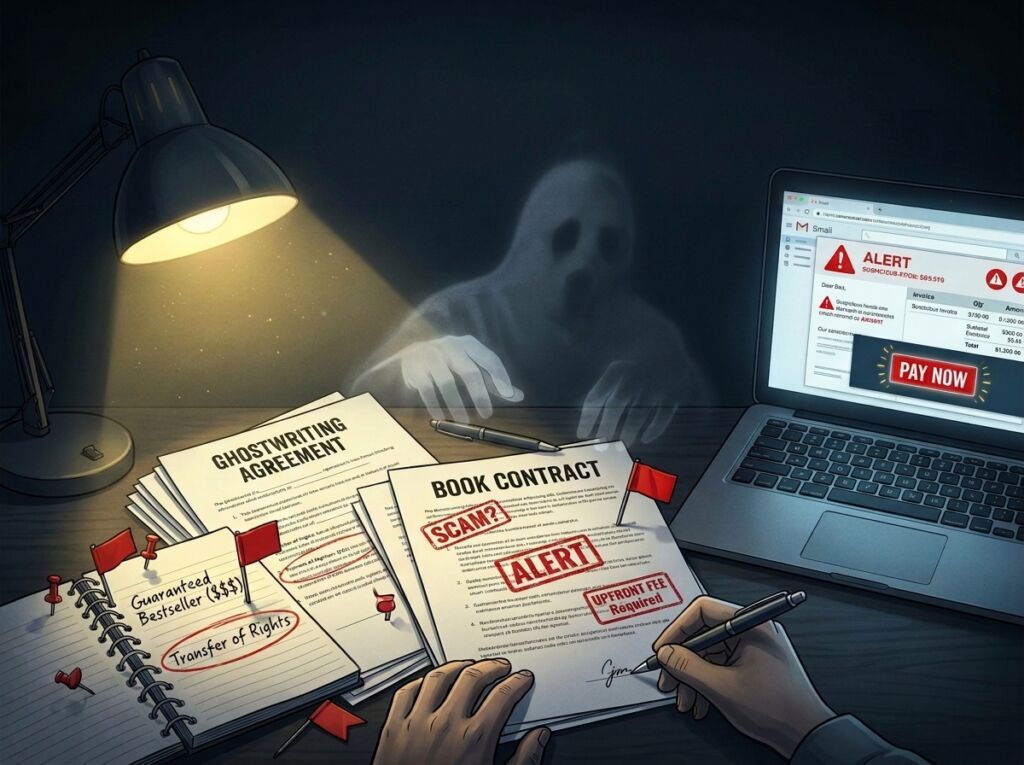
How do you spot a ghostwriting or book publishing scam? A legitimate ghostwriting or hybrid publishing agency will never demand 100% upfront payment, guarantee a New York Times bestseller spot, hide the identity of your writer, or claim ownership of your intellectual property and royalties. Before paying any publishing company, always request a live video interview with your assigned writer, verify the company’s domain age, insist on a milestone-based contract, and ensure your book is published directly through your own author accounts.
Deciding to write and publish a book is one of the most vulnerable, exciting investments you will ever make. Whether you are sharing a hard-won memoir, building a business legacy, or finally bringing a fiction world to life, your book matters.
Unfortunately, an entire shadow industry of predatory “vanity presses,” overseas content mills, and fake literary agencies exists solely to profit off aspiring authors. If you have already been burned by a shady agency—or if you have your credit card in hand right now and feel a knot of hesitation in your stomach—trust that instinct. Being cautious does not mean giving up on your book; it means protecting your story and your hard-earned money.
Before you sign a contract or wire a single dollar, use this protective guide to audit any company you are considering. If an agency triggers even two or three of these 12 red flags, walk away immediately.
1. The “Guaranteed Bestseller” Promise
Nothing sounds sweeter to a first-time author than a sales representative promising that your book will become a guaranteed New York Times, Wall Street Journal, or Amazon #1 Bestseller.
The Reality: No ethical publisher—not even Penguin Random House or HarperCollins—can guarantee that the public will buy a book. When a scam agency sells you a “$5,000 Bestseller Package,” they are usually running a category manipulation trick. They will upload your book into an obscure, hyper-specific Amazon subcategory (like 19th-Century Agricultural Reference) where buying just 10 copies in an hour triggers an orange “#1 New Release” banner for an afternoon. It does not generate real readers, real prestige, or real return on investment.
How to Protect Yourself: Ask for a clear list of marketing deliverables (such as ad spend, media outreach, or Amazon PPC management) rather than guaranteed outcomes. If they promise a specific sales rank, close the tab.
2. The $999 “All-Inclusive” Ghostwriting Package
If you click on a social media ad offering to ghostwrite, edit, design, and publish a 50,000-word book for $999 to $2,500, stop and do the math.
The Reality: Writing a high-quality book takes between 150 and 300 hours of interviewing, outlining, researching, drafting, and revising. No skilled, native-English-speaking professional can work for four months for $1,500. Agencies offering rock-bottom prices operate in one of two ways: either they prompt-generate lifeless, repetitive chapters using AI tools in twenty minutes, or they outsource your book to an overworked, underpaid freelancer in a content mill who knows nothing about your voice or industry.
How to Protect Yourself: Expect realistic market rates. Professional ghostwriting is a premium service. If your budget is tight, it is much safer to write a rough draft yourself and hire a reputable developmental editor than to buy a cheap ghostwriting package.
3. You Are Not Allowed to Speak With Your Writer
In many shady agencies, you spend weeks talking to a charming “Senior Literary Consultant” or “Acquisitions Director.” Yet the moment you ask to meet the actual person who will be writing your book, you are met with excuses: “We assign writers only after payment clears,” or “All communication goes through your Project Manager for quality control.”
The Reality: Ghostwriting is a deeply personal collaboration. A writer cannot capture your humor, your cadences, or your expertise if they never speak to you directly. Agencies hide their writers for one main reason: they don’t actually have a writer lined up yet, or the writer’s communication skills would immediately reveal that the agency lied about having an elite, US-based team.
How to Protect Yourself: Never pay a deposit until you have had a face-to-face Zoom call with the exact ghostwriter who will be drafting your manuscript—and make sure their name is written into your contract.
4. Demanding 100% of the Fee Upfront
A classic hallmark of a publishing scam is the demand for full payment before a single word is written—often disguised as a “15% Pay-in-Full Discount.”
The Reality: The moment you hand over 100% of the money, you lose 100% of your leverage. If the first chapter comes back reading like a high school essay, or if the company suddenly stops replying to your emails for six weeks, you have no financial recourse to hold them accountable.
How to Protect Yourself: Insist on a milestone-based payment schedule tied to your approval of the work. A fair industry structure looks like this:
-
25% upon signing the contract.
-
25% upon approval of the detailed book outline and Chapter 1.
-
25% upon approval of the halfway manuscript draft.
-
25% upon final delivery and revision sign-off.
5. Manufactured Urgency and High-Pressure Sales Tactics
Does the sales rep call you three times a day? Are they telling you that their “Editorial Board” only accepted three books this month, and if you don’t pay by 5:00 PM Friday, you will lose your slot—and your $2,000 scholarship discount?
The Reality: Real publishing professionals do not operate like used-car dealerships. High-pressure deadlines are designed to trigger emotional panic so you hand over your money before you have time to read reviews, consult a lawyer, or compare competitors.
How to Protect Yourself: Tell the representative, “I never sign contracts under a time limit. I need a week to have my attorney review the agreement.” A legitimate agency will respect your diligence. A scammer will get aggressive or manipulative.
6. The Royalty and Copyright Grab (Double-Dipping)
When you hire a ghostwriter or a self-publishing service provider, you are paying for the labor. However, predatory hybrid publishers love to slip clauses into their contracts taking 30% to 50% of your net royalties—and sometimes claiming exclusive rights to your intellectual property for seven years or more.
The Reality: In the publishing world, this is called “double-dipping.” Traditional publishers take a cut of your royalties because they pay you an advance and cover 100% of the production costs. If you are paying the agency thousands of dollars to produce the book, they have zero right to take a percentage of your future book sales.
How to Protect Yourself: Check your contract for the phrase “Work Made for Hire.” You must retain 100% of the copyright, 100% of the film/audiobook rights, and 100% of the net royalties from day one.
Quick Comparison: Predatory Scammers vs. Ethical Agencies
| Feature | Predatory / Scam Agency PNG | Ethical Ghostwriting / Publishing Partner |
| Writer Vetting | Refuses writer access before payment; routes everything through a project manager. | Facilitates live interviews with vetted writers before you sign. |
| Payment Structure |
Pressures you for 100% upfront or large automated monthly charges. |
Uses clear, deliverable-based milestones with approval gates. |
| Rights & Royalties | Takes a cut of your royalties and locks you into multi-year rights contracts. | Grants 100% copyright and 100% royalties via a “Work Made for Hire” clause. |
| Distribution Setup | Publishes the book under their company Amazon KDP account. | Sets up Amazon KDP and IngramSpark accounts in your name and bank details. |
| Exit Policy | No refund policy; impossible to cancel once signed. | Includes a clear “Kill Fee” or exit clause if the partnership isn’t working. |
7. Stolen Portfolios and Fake Celebrity Credentials
You open an agency’s website and see covers of famous books—maybe Atomic Habits, Becoming, or well-known New York Times bestsellers—implying their team ghostwrote or published them.
The Reality: Professional ghostwriting operates under strict Non-Disclosure Agreements (NDAs). A real ghostwriter cannot legally plaster a client’s book cover on a public website without explicit written permission—and famous authors almost never grant that permission. Scammers simply grab famous book covers off Google Images because they know most buyers won’t verify them.
How to Protect Yourself: Ignore website carousels of famous books. Instead, ask for anonymized writing samples in your genre, or pay a small, standalone fee for a custom 1,000-word sample chapter based on a 30-minute interview with your writer.
8. Cold Calls Claiming “Hollywood” or “Major Publishers” Want Your Book
If you have ever self-published a book in the past, you have likely received a flattering email or phone call: “Hello! Our scouting department read your book and believes it has massive potential for a Netflix adaptation / a re-launch with Simon & Schuster. All you need to do is pay $4,500 for our literary agent representation and pitch package.”
The Reality: Memorize Yog’s Law: Money always flows toward the author. Real literary agents, real traditional publishers, and real Hollywood scouts never cold-call authors asking for upfront fees to pitch, re-edit, or license a book. They make money strictly on commission after they sell your rights.
How to Protect Yourself: Hang up immediately. Many scammers impersonate real literary agents—always verify the sender’s actual email domain against the official agency website.
9. Unchecked AI Slop Disguised as Human Ghostwriting
Using AI to help organize an outline or transcribe an interview is fine. Charging a client $15,000 for “bespoke human ghostwriting” and handing them an unedited, soulless manuscript generated by an LLM is fraud.
The Reality: AI-generated manuscripts are easy to spot once you know what to look for: they rely on repetitive sentence structures, overuse hollow transition words (“Furthermore,” “In conclusion,” “A testament to”), lack specific sensory anecdotes, and flatten your unique personality into generic corporate prose. Worse, Amazon KDP requires strict disclosure of AI-generated text.
How to Protect Yourself: Ensure your contract explicitly states that the manuscript will be 100% human-written, and require the writer to incorporate specific stories, transcripts, and voice notes from your recorded interviews into every single chapter.
10. The “Hostage Manuscript” Upsell Trap
You sign up for a $4,000 writing and publishing package. Four months later, the draft is finished, and suddenly the tone of your project manager changes. You are told your book cannot be released unless you pay an extra $1,800 for “Mandatory Developmental Editing,” $900 for “Copyright & ISBN Registration,” and $3,500 for “Mandatory Retail Distribution.“
The Reality: This is the hostage model. Because you have already sunk $4,000 and months of emotional energy into the project, scammers know you will feel trapped into paying the surprise fees just to get your book across the finish line.
How to Protect Yourself: Demand an itemized, all-inclusive scope of work in your contract, along with a written clause stating: “No additional fees shall be required to deliver the final, print-ready and upload-ready files as outlined in this agreement.” (And for the record: a single US ISBN from Bowker costs $125, and registering your copyright at Copyright.gov costs $45 to $65—never pay an agency $1,000 for them).
11. Publishing Under the Agency’s Master Account
When it is time to publish your finished book, a shady agency will offer to “handle all the technical headaches” by uploading your book through their company’s Amazon KDP or IngramSpark account.
The Reality: Whoever controls the publishing dashboard controls the book. If your book lives inside an agency’s KDP account:
-
You cannot see your real-time, unfiltered sales data.
-
You have to trust them to calculate and wire you your royalties.
-
You cannot change your book price, update your book description, or fix a typo without paying them a fee.
-
If the agency goes bankrupt or disappears next year, your book is locked in their account forever.
How to Protect Yourself: Only work with professionals who help you set up your own Amazon KDP and IngramSpark accounts under your own email address and tax ID, where Amazon deposits 100% of your royalties directly into your personal bank account.
12. Fake Addresses, Brand-New Domains, and Ghost Teams
Scam publishing houses operate like hydra heads: when one company name gets flooded with Better Business Bureau (BBB) complaints and angry Trustpilot reviews, they shut it down on Friday and launch a brand-new website on Monday.
The Reality: These websites look incredible. They boast about “20 Years of Industry Experience” and list a prestigious address on Madison Avenue in New York or Wilshire Boulevard in Los Angeles. Yet if you look up the address on Google Street View, it is a virtual mailbox store. If you search the company on LinkedIn, not a single real editor or writer lists it as their employer.
How to Protect Yourself: Do a five-minute forensic check before you ever hop on a sales call:
-
Run a WHOIS Lookup: Go to lookup.icann.org or whois.com and type in their website URL. If they claim to have been in business for 10 years, but their domain was registered eight months ago, they are lying.
-
Check Writer Beware & ALLi: Search the company’s name on the Writer Beware blog (run by Victoria Strauss) and the Alliance of Independent Authors (ALLi) Watchdog Ratings.
-
Filter the Reviews: Ignore 5-star Trustpilot reviews that came in giant clusters over a single week with generic praise like “Great service by project manager Kevin!” Read the 1-star and 2-star reviews—that is where the real patterns hide.
The 5-Step Pre-Payment Safety Checklist
Before you sign any ghostwriting or publishing agreement, make sure you can answer “Yes” to all five of these questions:
-
Have I spoken on camera with the exact writer or editor who will work on my book?
-
Does the contract guarantee that I retain 100% of my copyrights and 100% of my net royalties?
-
Are payments broken into at least 3 to 4 milestones tied to my written approval of the work?
-
Is there a clear “Kill Clause” allowing me to walk away with my completed chapters if I am unhappy with the direction?
-
Will the final book be uploaded directly to my personal publishing accounts rather than the agency’s account?
Frequently Asked Questions (FAQs)
How much does a legitimate ghostwriter actually cost?
A legitimate, experienced professional ghostwriter typically charges between $15,000 and $45,000+ for a full-length book (roughly $0.35 to $1.00+ per word), depending on the complexity of the research and the writer’s track record. Reputable editorial and self-publishing assistance (editing, cover design, and formatting—without ghostwriting) generally costs between $3,000 and $8,000. Anything drastically below these numbers should be treated with extreme caution.
What is the difference between a vanity press and a legitimate hybrid publisher?
A vanity press makes almost all of its profit from selling overpriced production and “marketing” packages to authors; they will accept any manuscript regardless of quality, take a cut of your royalties, and do nothing to actually sell your book to readers. A legitimate hybrid publisher vets manuscripts selectively for quality, adheres to strict industry standards (such as those set by the Independent Book Publishers Association), offers transparent fee-for-service pricing, and provides real distribution support.
What should I do if I have already paid a scam publishing agency?
If you realize you have been scammed, take action immediately:
-
Contact Your Bank or Credit Card Provider: File a formal chargeback or fraud dispute for “services not rendered as described.” Credit cards offer the strongest buyer protection (usually within 60 to 120 days of the transaction).
-
Stop Sending Money: Never pay an “exit fee,” “copyright release fee,” or final installment to rescue a hostage manuscript—they will rarely release it anyway.
-
Document Everything: Save every email, contract, invoice, and text message.
-
Report the Company: File complaints with the Federal Trade Commission (FTC), your state Attorney General, the Better Business Bureau (BBB), and Writer Beware (
beware@sfwa.org) to help warn other authors.
Your story deserves to be written, and it deserves to be treated with respect. Taking your time, asking hard questions, and demanding a fair contract will never scare away an honest ghostwriter or a legitimate publishing professional—in fact, the right partner will respect you for it. Protect your work, trust your instincts, and only partner with people who are as invested in your book’s integrity as you are.