


Quick Answer / TL;DR
- A skilled ghostwriter doesn’t invent your voice. They extract it through a structured interview process that typically spans 8–15 hours of recorded conversations.
- The interview method works in six phases: discovery call, deep-dive author interviews, voice-profile creation, sample chapter test, revision loop, and full manuscript drafting.
- Professional ghostwriters listen for your sentence rhythm, go-to phrases, storytelling patterns, humor style, and emotional tone, not just your story facts.
- You stay in control throughout: reviewing chapter drafts, flagging anything that doesn’t sound like you, and approving every word before publication.
- Expect the interview phase alone to take 3–6 weeks before any actual writing begins.
Your biggest fear about hiring a ghostwriter probably isn’t the cost. It’s this: Will the book actually sound like me?
That fear makes sense. And understanding how ghostwriters capture your voice through a proven, structured interview method is the first step toward trusting the process. You’ve spent decades building a career, surviving setbacks, developing opinions that are yours alone. The idea of handing all of that to a stranger and getting back something that reads like a Wikipedia entry? Terrifying.
Here’s the truth most ghostwriting companies won’t explain in detail: capturing your authentic voice is a process, not a talent. The best professional ghostwriters don’t rely on instinct or guesswork. They use a structured interview method, and that method is what separates a manuscript that feels ghostwritten from one that feels like you sat down and wrote every word yourself.
Below, you’ll see exactly how that process works, phase by phase, with the kinds of questions a ghostwriter actually asks and the voice markers they’re trained to identify.
How Ghostwriters Capture Your Voice: What It Actually Means
When ghostwriters talk about “voice,” they’re not just referring to vocabulary. Voice is the combination of at least seven distinct elements:
| Voice Element | What the Ghostwriter Listens For |
| Sentence length | Do you speak in short, punchy bursts or longer, layered thoughts? |
| Vocabulary level | Do you use industry jargon, colloquial slang, or plain English? |
| Storytelling structure | Do you start with the punchline or build up slowly? |
| Humor style | Dry wit, self-deprecating, observational, or none? |
| Emotional register | Reserved and factual, or openly vulnerable? |
| Rhythm and pacing | Fast and energetic, or measured and reflective? |
| Signature phrases | Repeated expressions, analogies, or metaphors you default to |
A ghostwriter who only gathers your story but ignores these markers will produce a manuscript that’s accurate but lifeless. The interview method is specifically designed to capture both: what you want to say and how you naturally say it.
Belmont Publisher insider tip: Our editorial team builds a written “voice profile” document for every ghostwriting client before a single chapter is drafted. It typically runs 3–5 pages and includes sample phrases, tone notes, pacing preferences, and a list of words the author would never use. This profile becomes the ghostwriter’s north star for the entire manuscript.
The 6-Phase Ghostwriting Interview Method
Here’s how the interview process works at a professional level, from first contact to final manuscript.
Phase 1: The Discovery Call (30–60 Minutes)
This isn’t a sales pitch. It’s a compatibility check. The ghostwriter needs to understand:
- What kind of book you want to write (memoir, business book, self-help, fiction)
- Why you want to write it now
- Who your ideal reader is
- What your timeline and budget look like
- Whether your personalities are compatible for a 4–12 month collaboration
You should walk away from this call knowing whether you trust the ghostwriter enough to share your real stories, not the polished version you tell at dinner parties.
Phase 2: Deep-Dive Author Interviews (8–15 Hours, Spread Over 3–6 Weeks)
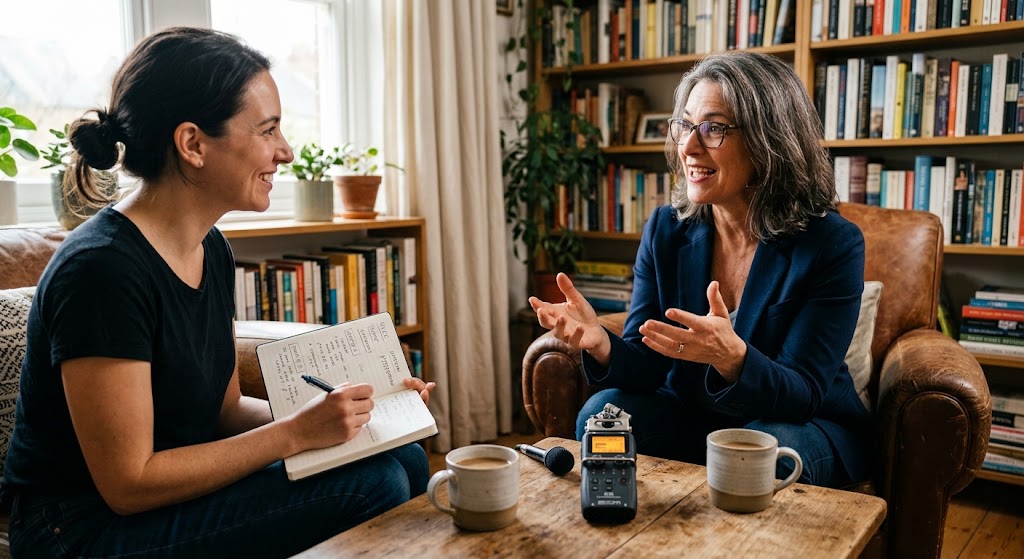
This is the core of the method. Professional ghostwriters conduct anywhere from 6 to 12 recorded interview sessions, each lasting 60–90 minutes. These are not random conversations. Each session targets a specific section of the book outline.
What a ghostwriter is actually doing during these interviews:
- Recording everything (with your permission) for transcription
- Noting your natural word choices, not the “polished” answers, but the raw, unfiltered way you describe events
- Identifying emotional peaks: the moments your energy shifts, your pace changes, or your voice drops
- Tracking your narrative instincts: do you explain with data, anecdotes, metaphors, or direct opinions?
- Flagging your verbal tics and signature phrases (these become authenticity markers in the manuscript)
Sample ghostwriting interview questions you might hear:
- “Tell me about a time you almost quit. What did that morning feel like?”
- “If you were explaining this concept to your best friend over a beer, how would you say it?”
- “What’s the one thing readers will disagree with you about, and why are you right?”
- “Walk me through that day. Not the summary, the actual sequence, starting from when you woke up.”
- “What would your mother say about this chapter?”
Notice these aren’t yes/no questions. They’re designed to pull out your natural storytelling voice, not just facts.
Phase 3: Voice Profile Creation (1–2 Weeks)
After transcribing all your interviews, the ghostwriter (or editorial team) builds a formal voice profile. This document typically includes:
- Vocabulary preferences: Words you use frequently vs. words that would sound wrong coming from you
- Sentence structure patterns: Your average sentence length, your use of fragments, your punctuation tendencies
- Tone spectrum: How your voice shifts depending on topic (e.g., warmer when discussing family, sharper when discussing business competitors)
- Storytelling style: Whether you lead with context or conflict, whether you use dialogue, how much sensory detail you naturally include
- Off-limits list: Phrases, tones, or approaches that would make the manuscript feel inauthentic
A thorough voice profile is what separates professional book editing from surface-level proofreading. It gives every editor and ghostwriter on the project a shared reference point for how you sound on the page.
Phase 4: Sample Chapter Test (2–3 Weeks)
Before committing to a full manuscript, a professional ghostwriter produces one sample chapter, usually 3,000–5,000 words, for your review. This is your first chance to see your voice on the page.
You’re looking for one thing: Does this sound like me?
Not “Is this good writing?” Not “Is this what I expected?” Just: if someone who knows you well read this chapter with no context, would they believe you wrote it?
If the answer is no, the ghostwriter adjusts. This is normal. Most projects require 1–3 rounds of voice calibration before the ghostwriter truly locks in.
Phase 5: Full Manuscript Drafting with Ongoing Check-Ins
Once the sample chapter is approved, the ghostwriter moves into full production. For a standard 50,000–70,000-word book, expect:
- Drafting timeline: 3–6 months
- Chapter delivery cadence: 1–2 chapters per week for your review
- Check-in interviews: Brief 30-minute calls every 1–2 weeks to clarify details, fill gaps, or recalibrate voice
You’re not waiting in the dark for six months. You’re reviewing chapters as they come in, flagging anything that feels off, and giving the ghostwriter real-time feedback.
Phase 6: Revision, Formatting, and Final Approval
The first full draft isn’t the final product. Professional ghostwriting projects typically include:
- 1–2 full revision rounds where you provide detailed feedback on every chapter
- A line-level polish pass where the ghostwriter or a separate editor tightens prose, checks consistency, and ensures voice stays uniform from Chapter 1 to the final page
- Your written sign-off before the manuscript moves to book cover design, interior formatting (EPUB and print-ready PDF), and publishing on platforms like Amazon KDP, IngramSpark, or Barnes & Noble Press
Once approved, you’ll also need an ISBN through Bowker (MyIdentifiers.com), the only official US ISBN source, and you may want to register your copyright at Copyright.gov before your publication date.
How Long Does the Ghostwriting Interview Process Take?
Here’s a realistic timeline breakdown for a standard nonfiction book:
| Phase | Duration |
| Discovery call + onboarding | 1–2 weeks |
| Deep-dive interviews (8–15 hours) | 3–6 weeks |
| Voice profile creation | 1–2 weeks |
| Sample chapter + revisions | 2–4 weeks |
| Full manuscript drafting | 3–6 months |
| Revisions + final approval | 3–6 weeks |
| Total project timeline | 5–10 months |
Your commitment during the interview phase is roughly 1–2 hours per week. The ghostwriter does the heavy lifting between sessions: transcribing, organizing, outlining, and beginning to draft.
How Much Does Ghostwriting With Voice Capture Cost?
Pricing varies widely, but here are current US market ranges for 2025–2026:
| Service Level | Typical Cost Range | What’s Included |
| Budget ghostwriter (freelance) | $5,000–$15,000 | Basic interviews, one draft, limited revisions |
| Mid-range professional | $20,000–$40,000 | Full interview method, voice profile, 2 revision rounds |
| Premium ghostwriting firm | $40,000–$100,000+ | Dedicated team, deep interviews, unlimited revisions, project management, publishing support |
The price difference largely comes down to how thorough the interview and voice-capture process is. A $7,000 ghostwriter might do two or three phone calls and start writing. A $40,000 firm is spending 15+ hours in interviews, building a detailed voice profile, and assigning a project manager to keep everything on track.
The Alliance of Independent Authors (ALLi) recommends vetting ghostwriters carefully and checking for a structured process before signing any contract. Cost alone doesn’t guarantee quality.
Belmont Publisher insider tip: If a ghostwriter quotes you a price without mentioning an interview process at all, that’s a red flag. Voice capture isn’t optional. It’s the foundation of every manuscript that actually sounds like its author. You can review our pricing and process to see how a structured engagement is typically scoped.
5 Red Flags That a Ghostwriter Won’t Capture Your Voice
Before you sign a contract, watch for these warning signs:
- They don’t ask to interview you. They just want a written brief or bullet points.
- They can’t show you voice-matched samples from previous clients (with permission or anonymized).
- They skip the sample chapter and jump straight to drafting the full manuscript.
- They don’t record interviews. Relying on handwritten notes alone misses the nuances of how you speak.
- They push back when you say something “doesn’t sound like me”. A good ghostwriter treats that feedback as data, not criticism.
Reedsy’s ghostwriter directory is one solid starting point for finding vetted professionals, though you’ll still want to ask every candidate about their voice-capture process before committing.
Frequently Asked Questions
How do ghostwriters capture your voice if you’ve never written a book before? Your voice isn’t in your writing; it’s in your speaking. Professional ghostwriters extract voice from recorded conversations, not from written samples. Even if you’ve never typed more than an email, a skilled ghostwriter can capture your natural rhythm, vocabulary, humor, and storytelling style through 8–15 hours of structured interviews.
Can a ghostwriter match my voice for a memoir? Yes, memoirs are actually where voice matching matters most. The interview method focuses heavily on emotional tone, personal storytelling habits, and the specific way you describe pivotal life moments. Your ghostwriter listens for how you talk about hard experiences, not just what happened.
How many interviews does a ghostwriter typically need? Most professional ghostwriting projects require 6–12 interview sessions of 60–90 minutes each, totaling 8–15 hours of recorded conversation. Some complex projects (multi-decade memoirs, technical books with heavy research) may need 20+ hours.
What if the ghostwriter’s sample chapter doesn’t sound like me? That’s expected and normal. The sample chapter exists precisely for this reason. It’s a calibration tool. You give specific feedback (“I’d never use this word,” “This section feels too formal”), and the ghostwriter adjusts the voice profile. Most projects need 1–3 rounds before the voice locks in.
Will people be able to tell I used a ghostwriter? Not if the voice capture is done properly. The interview method produces manuscripts that match your natural speech patterns so closely that even friends and family typically can’t tell. The key is a ghostwriter who prioritizes voice over their own writing style.
How involved do I need to be during the ghostwriting process? Plan for 1–2 hours per week during the interview phase (3–6 weeks) and 2–3 hours per week during manuscript review (reading chapters as they’re delivered). Total author time commitment for a full book is roughly 40–80 hours spread over 5–10 months.
Do ghostwriters use NDAs to protect my privacy? Yes. Reputable ghostwriting firms require a mutual NDA before the first interview. This protects your story, your personal information, and the fact that you used a ghostwriter, if you prefer to keep that private. Your publishing contract should specify confidentiality terms clearly.
What happens after the manuscript is finished? Once you approve the final manuscript, it moves into production: interior formatting (for both EPUB and print-on-demand), cover design, ISBN registration through Bowker, and publishing on platforms like Amazon KDP, IngramSpark, or Barnes & Noble Press. Many authors also consider book marketing services to support their launch.
Your Voice Deserves the Right Process
The difference between a forgettable ghostwritten book and one that feels unmistakably yours comes down to one thing: how seriously the ghostwriter treats the interview process.
If someone promises to write your book after a single phone call, they’re not capturing your voice. They’re guessing at it.
The right ghostwriter will ask you hard questions, record your answers, study how you tell stories, build a detailed profile of your speech patterns, and test their accuracy with a sample chapter before writing a single page of the real manuscript.
If you’re exploring the idea of working with a professional ghostwriter, and you want to make sure your voice stays front and center, Belmont Publisher offers a free discovery call with a US-based publishing consultant who can walk you through exactly how the process works for your specific book.