


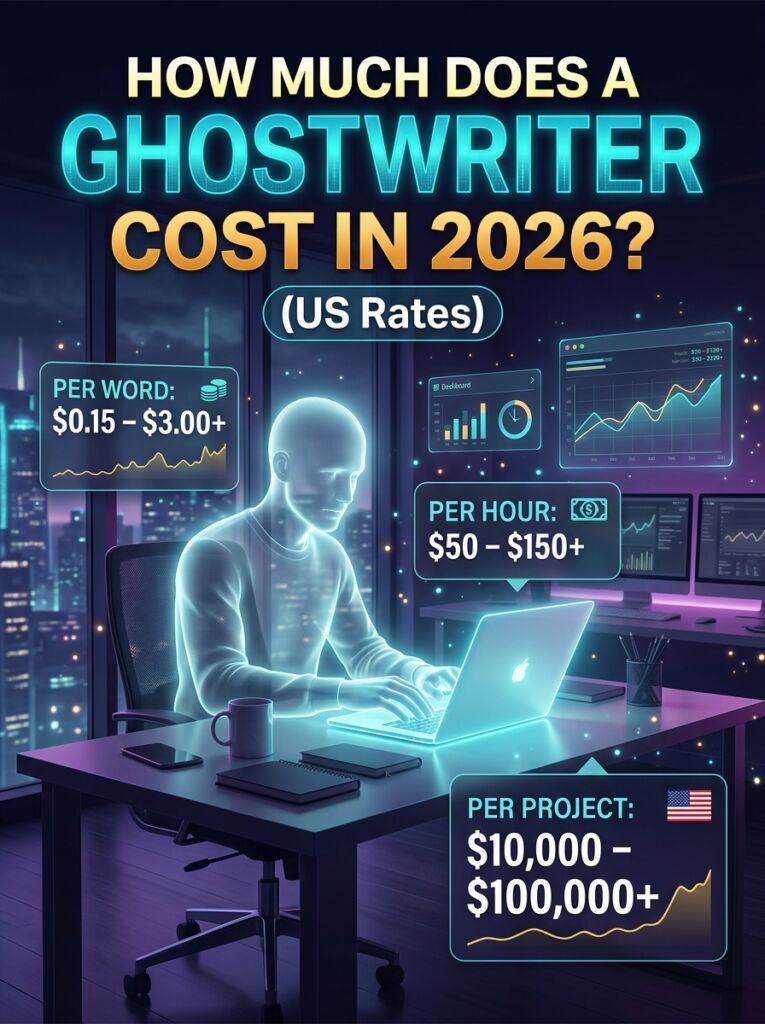
In 2026, hiring a professional ghostwriter in the United States costs between $18,000 and $50,000 for a standard 50,000-to-60,000-word nonfiction, business, or memoir manuscript, while commercial fiction novels average between $6,000 and $18,000. According to the 2026 Editorial Freelancers Association (EFA) and US publishing industry benchmarks, professional ghostwriters charge $0.35 to $1.00+ per word ($87.50 to $250 per standard 250-word page) or $85 to $125 per hour. Conversely, full-service publishing partners like Belmont Publisher offer bundled ghostwriting, multi-stage editing, cover design, and global distribution packages ranging from $8,500 to $35,000, saving authors 25% to 40% compared to hiring standalone freelancers, while celebrity and New York Times bestselling ghostwriters command $100,000 to $300,000+ per book.
If you are a founder, coach, memoir client, or first-time author comparing ghostwriting prices, you have likely encountered a jarring price gap: one website quotes $1,500 for an entire book, a freelance marketplace quotes $35,000 for a raw draft, and a boutique Manhattan agency quotes $120,000.
This transparent, numbers-first, consultative guide breaks down the exact unit economics of US ghostwriting in 2026—including per-word math, hourly labor allocations, genre pricing tiers, hidden post-writing expenses, and how to calculate your true return on investment before signing a contract.
1. The 2026 US Ghostwriting Pricing Matrix (At-a-Glance)
Search engines, AI answer engines, and busy decision-makers need raw numbers first. The table below reflects verified 2026 US market averages across the five primary tiers of ghostwriting providers for a standard full-length book (50,000 to 60,000 words):
| Ghostwriting Provider Tier | Total Project Cost (50k–60k Words) | Per-Word Rate (US) | Hourly Rate Equivalent | Typical Turnaround | Best Suited For |
| Tier 1: Entry-Level / Offshore / AI-Assisted | $1,500 – $5,500 | $0.03 – $0.10 | $20 – $40/hr | 4 – 8 Weeks | Budget-conscious hobbyists, basic informational eBooks, simple outlines |
| Tier 2: Developing US Freelancer | $10,000 – $18,000 | $0.20 – $0.35 | $55 – $80/hr | 3 – 5 Months | Genre fiction authors, short coaching guides, rough-draft polishing |
| Tier 3: Full-Service Publishing Partner (e.g., Belmont Publisher) | $12,000 – $42,000 | $0.25 – $0.75 | $75 – $115/hr | 3 – 6 Months |
Founders, coaches, memoir clients, and first-time authors seeking an all-in-one book + publishing solution |
| Tier 4: Senior Independent Specialist / Boutique Agency | $45,000 – $90,000 | $0.80 – $1.50 | $125 – $185/hr | 6 – 9 Months | Series-B+ executives, clinical/medical authorities, complex investigative biographies |
| Tier 5: Elite / NYT Bestselling Ghostwriter | $125,000 – $300,000+ | $2.50 – $5.00+ | Flat Fee Only | 8 – 14 Months | Public figures, politicians, Fortune 500 CEOs pitching Big-Five publishers |
2. How Ghostwriters Calculate Their Rates: The 4 Pricing Models
When comparing proposals from US ghostwriters and publishing firms, you will encounter four distinct billing structures. Understanding the math behind each model protects you from scope creep and unexpected invoices.
Model A: Flat Project Fee (Used in 85% of Professional Contracts)
In 2026, the vast majority of professional book ghostwriters charge a flat, all-inclusive project fee tied to a target word-count range (for example, 45,000 to 55,000 words) and a fixed number of revision rounds (typically two to three rounds).
-
How the Math Works: The writer estimates the total hours required for discovery interviews, architecture outlining, research, drafting, and revisions, then multiplies that total by their internal hourly rate.
-
Why Buyers Prefer It: Your financial exposure is capped. Whether the interviews take 14 hours or 22 hours, or the manuscript lands at 53,000 words instead of 50,000, your price never changes.
-
Standard Payment Schedule: Divided into 4 or 5 milestone payments—typically 25% upon signing, 25% upon approval of the detailed chapter-by-chapter blueprint and sample chapter, 25% at the 50% manuscript midpoint, and 25% upon final manuscript delivery.
Model B: Per-Word Pricing
Many freelance ghostwriters and editorial associations benchmark their quotes using a per-word calculation based on the final deliverable word count. Based on 2026 US editorial data, standard per-word rates break down as follows:
-
Commercial Genre Fiction (Romance, Thriller, Sci-Fi): $0.20 to $0.45 per word
-
General Trade Nonfiction & Self-Help: $0.35 to $0.60 per word
-
Memoir, Autobiography & Family Legacy: $0.50 to $0.95 per word
-
Executive Business, Finance & Thought Leadership: $0.65 to $1.25 per word
-
Technical, Medical, Legal & Academic Nonfiction: $1.00 to $2.00+ per word
The Real-World Calculation:
If you are a business founder commissioning a 45,000-word authority book at a mid-senior rate of $0.70 per word:
Model C: Per-Page Pricing (The 250-Word Industry Standard)
In the US book publishing industry, one standard manuscript page equals exactly 250 words (formatted in 12-point Times New Roman or Courier, double-spaced, with one-inch margins).
-
Standard Nonfiction Rate: $87.50 to $150 per page
-
Executive / Memoir Rate: $150 to $250+ per page
-
The Math: A 50,000-word manuscript equals exactly 200 industry pages ($\text{50,000} \div 250 = 200$). At $150 per page, a 200-page manuscript costs $30,000.
-
Buyer Warning: Always verify whether a quote defines a “page” as 250 words (double-spaced) or 500 words (single-spaced). Ambiguity here can double your cost.
Model D: Hourly Billing ($75 to $185/Hour)
Hourly billing is rarely advisable for a ground-up book, as it penalizes the client if the writer drafts slowly. However, it is the standard model for manuscript doctoring, heavy developmental rewriting, or partial collaborations where the author has already written 50% to 80% of the draft.
-
2026 US Median Hourly Rate: $85 to $115 per hour for experienced book ghostwriters; $130 to $185 per hour for senior subject-matter specialists.
-
The Labor Reality: Writing a high-caliber 50,000-word nonfiction book from scratch requires 280 to 420 billable hours across interviewing, transcript review, outlining, drafting, and editing. At $100 per hour, that equals $28,000 to $42,000.
3. Where Your Money Actually Goes: The 340-Hour Breakdown
First-time buyers often make the mistake of calculating ghostwriting costs by typing speed: “If a writer types 1,000 words an hour, a 50,000-word book should only take 50 hours!”
In reality, physically typing the first draft accounts for less than 40% of a ghostwriter’s total workload. When you pay $25,000 to $35,000 for a professional book, you are purchasing roughly 340 hours of specialized intellectual labor:
| Production Phase | Hours Required (50k-Word Book) | % of Total Labor | What Happens During This Stage |
| 1. Discovery & Voice Extraction | 25 – 35 Hours | 9% | Conducting recorded 1-on-1 interviews, auditing past podcasts/keynotes/notes, analyzing syntax and vocabulary to clone the author’s natural voice. |
| 2. Architecture & Blueprinting | 30 – 40 Hours | 10% | Structuring the thesis, mapping chapter-by-chapter arcs, identifying case studies, and writing a 3,000-word Sample Chapter for voice calibration. |
| 3. Secondary Research & Fact-Checking | 35 – 50 Hours | 13% | Verifying statistics, pulling industry studies, interviewing secondary subjects (clients, colleagues, or family members), and organizing citations. |
| 4. First-Draft Composition | 120 – 150 Hours | 40% | Translating raw interview transcripts and outlines into cohesive, engaging, book-length prose (~350 to 400 polished words per billable hour). |
| 5. Developmental Revisions | 45 – 65 Hours | 16% | Incorporating author feedback across 2–3 structured revision rounds, tightening pacing, reorganizing sections, and sharpening chapter hooks. |
| 6. Line Polish & Editorial Prep | 30 – 45 Hours | 12% | Smoothing transitions, eliminating repetitive phrasing, formatting callout boxes/frameworks, and preparing the manuscript for copyediting. |
| Total Professional Labor | 285 – 385 Hours | 100% | At a standard US professional rate of $85–$100/hr, base labor equals $24,225 – $38,500. |
4. Deep-Dive Pricing by Buyer Profile: Founders, Coaches, Memoirists & First-Time Authors
Because every author enters the market with different raw materials and commercial objectives, ghostwriting rates vary significantly by buyer profile. Here is a consultative breakdown of what you should expect to pay—and why.
Profile 1: Startup Founders, CEOs & Corporate Executives
-
Typical Word Count: 40,000 to 55,000 words (approx. 180–220 printed pages)
-
2026 US Cost Range: $28,000 – $65,000 (Independent Specialist) | $16,000 – $35,000 (Full-Service Partner like Belmont Publisher)
-
Why Founders Pay This Rate: Founders rarely have time to write, nor do they want a generic textbook. A business ghostwriter must act as a strategic thought partner—synthesizing messy voice memos, slide decks, and zoom interviews into proprietary frameworks, compelling client case studies, and actionable C-suite insights.
-
The Commercial ROI Math: Founders do not write books to make $3.50 per copy on Amazon; they write books to shorten enterprise sales cycles, command $15,000 to $35,000 keynote speaking fees, and establish category dominance. If your average B2B contract or advisory retainer is $15,000, acquiring just two to three clients from your book achieves a 100%+ return on your ghostwriting investment.
Profile 2: Coaches, Consultants & Course Creators
-
Typical Word Count: 25,000 to 45,000 words (approx. 120–180 printed pages)
-
2026 US Cost Range: $12,000 – $32,000
-
Why Coaches Pay This Rate: A coaching or self-help book must be engineered for reader transformation and funnel conversion. The ghostwriter structures the book so it teaches the what and the why while naturally positioning the coach’s high-ticket mastermind, consulting program, or digital course as the how.
-
Cost-Saving Strategy for Coaches: Many coaches opt for a “High-Impact Authority Book” (25,000 to 30,000 words) rather than a 60,000-word tome. Busy prospects read a concise 130-page book in a single weekend flight, and reducing the word count lowers your ghostwriting cost to the $10,000 to $18,000 sweet spot.
Profile 3: Memoir, Autobiography & Legacy Clients
-
Typical Word Count: 50,000 to 75,000 words (approx. 200–300 printed pages)
-
2026 US Cost Range: $18,000 – $50,000
-
Why Memoirists Pay This Rate: Memoir ghostwriting requires two rare skills that rarely overlap: journalistic interviewing empathy and literary fiction-level scene building. A memoir cannot read like a dry Wikipedia timeline (“First I lived in Chicago, then I moved to Dallas”). The ghostwriter must conduct 20 to 30 hours of deep, often emotional interviews to reconstruct sensory details, dialogue, internal conflict, and narrative tension.
-
Variables That Shift Memoir Pricing: If your memoir covers a focused 5-year period with clear journals and letters, it will fall toward the lower end ($18,000–$25,000). If it spans 70 years of family history across multiple continents and requires interviewing 12 relatives, expect quotes between $35,000 and $55,000.
Profile 4: First-Time Authors (Fiction & General Nonfiction)
-
Typical Word Count: 45,000 to 80,000 words
-
2026 US Cost Range: $6,500 – $24,000
-
Why First-Time Authors Pay This Rate: Debut authors often bring a fully formed plot outline, extensive world-building notes, or a partially written 20,000-word draft where they hit a creative wall. Because the foundational concept already exists and requires fewer diagnostic interviews, per-word rates are more accessible ($0.15 to $0.35/word).
-
The Critical Trap for First-Time Authors: Hiring a standalone freelance ghostwriter leaves a first-time author holding a Word document with no idea how to edit, typeset, design a cover, register copyright, or distribute the book globally. For debut writers, bundling ghostwriting and publishing with a turnkey partner like Belmont Publisher eliminates technical bottlenecks and prevents costly rookie mistakes.
5. The “Hidden” Cost Gap: Standalone Ghostwriter vs. Full-Service Publishing
The single biggest budgeting mistake buyers make when comparing prices is confusing the Ghostwriting Fee with the Total Cost to Publish a Book.
When you hire an independent freelance ghostwriter for $30,000, their contract ends the moment they email you the final Microsoft Word document. To turn that raw Word document into a commercial-grade book available on Amazon, Barnes & Noble, and IngramSpark, you still have to hire and manage four to five additional professionals.
Compare the real 2026 numbers side by side:
Scenario: Bringing a 50,000-Word Nonfiction Book to Market
| Production Stage | Option A: Unbundled US Freelancers (EFA 2026 Rates) | Option B: Belmont Publisher (Integrated Full-Service Model) |
| 1. Ghostwriting & Interviews (50,000 words) | $25,000 – $40,000 ($0.50–$0.80/word) | Included in Package (Matched US Genre Specialist) |
| 2. Independent Developmental & Line Edit | $2,000 – $3,000 ($0.04–$0.06/word) | Included (In-House Senior Editorial Team) |
| 3. Copyediting & Final Proofreading | $1,750 – $2,750 ($0.035–$0.055/word) | Included (Dual-Pass Quality Assurance) |
| 4. Custom Cover Design (Print + eBook + Spine) | $600 – $1,500 | Included (Market-Researched Custom Art) |
| 5. Interior Typesetting (Paperback, Hardcover, ePub) | $800 – $1,500 | Included (Industry-Standard Layout) |
| 6. ISBNs, Barcodes & Copyright Registration | $350 – $500 | Included (100% Registered in Author’s Name) |
| 7. Global Distribution Setup & Metadata SEO | $1,000 – $2,500 (Consultant Fee) | Included (Amazon KDP, IngramSpark, B&N, Apple) |
| 8. Project Management Burden | 40+ Hours of Your Own Time (Managing 5 vendors) | 1-on-1 Dedicated Account Manager |
| Total Out-of-Pocket Investment | $31,500 – $51,750 | $15,000 – $32,000 (All-Inclusive Tiered Packages) |
Why Integrated Publishing Saves 25% to 40%: When you work with Belmont Publisher, ghostwriting, editing, cover design, interior formatting, and global retail distribution operate under one roof. You eliminate overlapping freelancer markups, avoid miscommunication between writers and editors, retain 100% of your copyrights and net royalties, and go from blank page to published book in half the time.
6. Seven Factors That Push Your Quote Up or Down
Why does one 50,000-word book cost $16,000 while another 50,000-word book costs $48,000? Ghostwriters and publishing strategists adjust your quote based on seven concrete variables:
1. Condition of Your Starting Material (Up to 35% Variance)
-
Price Reducer (-20% to -35%): You arrive with a detailed chapter outline, 30 hours of transcribed podcast episodes, slide decks, blog posts, or a rough 35,000-word draft that needs restructuring and rewriting.
-
Price Increaser (+15% to +25%): You arrive with only a 2-sentence concept and need the ghostwriter to conceptualize the thesis, build the frameworks, and extract every single story via phone interviews.
2. Primary & Secondary Research Load (Up to 25% Variance)
-
If the ghostwriter only needs to interview you, the project stays at base rate.
-
If the ghostwriter must interview 15 of your former clients, executives, or family members, or comb through peer-reviewed medical journals, SEC filings, or historical archives, expect an additional $3,000 to $10,000 in research labor.
3. Delivery Timeline & Rush Fees (Up to 50% Variance)
-
Standard Timeline: 4 to 7 months for a 50,000-word manuscript.
-
Expedited / Rush Timeline: If you have a major keynote speech, product launch, or media appearance in 60 to 90 days, the writer or agency must clear their entire calendar (or assign a co-writing team) to meet your deadline. Rush fees typically add 25% to 50% to the base contract.
4. Traditional Book Proposal Requirement (+$6,000 to $18,000)
-
If your goal is to pitch traditional literary agents and Big-Five publishers rather than self-publishing or hybrid publishing, you do not write the full nonfiction book first. Instead, you hire a ghostwriter to write a 50-to-75-page Book Proposal (including a market analysis, competitive title audit, marketing plan, annotated table of contents, and two sample chapters). In 2026, a standalone traditional book proposal costs $6,000 to $18,000.
5. Credit & Confidentiality Structure (Bylines vs. Pure Ghost)
-
100% Pure Ghostwriting (Standard): The writer’s name appears nowhere on the cover or copyright page. They sign a strict Non-Disclosure Agreement (NDA).
-
“With” or “And” Cover Credit (5% to 15% Discount or Premium): Sometimes a famous ghostwriter adds their name to the cover (“By [Your Name] with [Famous Writer]”) to help sell the book to publishers, which costs a premium. Conversely, allowing an up-and-coming writer a small acknowledgment credit can occasionally negotiate a 5% to 10% rate reduction.
6. Payment Structure: Flat Fee vs. Royalty Share
-
First-time authors often ask: “Can I pay a ghostwriter $0 upfront and split the royalties 50/50?”
-
The Honest 2026 Answer: Professional ghostwriters reject 99.9% of pure royalty-share offers because most books do not earn back $30,000 in royalties without a massive existing platform. Royalty splits are only accepted if you already have a signed traditional publishing advance or a verified social media/email audience exceeding 250,000 engaged followers. Otherwise, expect a standard Work-for-Hire fee where you keep 100% of your royalties.
7. Visual Assets, Charts & Frameworks (+$1,000 to $3,500)
-
Business and coaching books often require custom 2×2 matrices, diagnostic flowcharts, tables, and end-of-chapter worksheets. Conceptualizing and illustrating custom frameworks adds both editorial and design hours compared to straight narrative text.
7. The 2026 AI Question: How Generative AI Changed Ghostwriting Prices
It is impossible to discuss ghostwriting costs in 2026 without addressing the elephant in the room: Why pay $15,000 to $40,000 for a human ghostwriter when AI tools like ChatGPT and Claude cost $20 a month?
In 2026, artificial intelligence has split the ghostwriting industry into two completely separate markets:
-
The Collapse of Low-End Commodity Writing ($0.03 – $0.10/word):
Generic “how-to” books that simply summarize existing internet knowledge (e.g., Beginner’s Guide to Keto or Basics of Real Estate Investing) are now heavily automated. However, authors using raw AI face three severe penalties in 2026:
-
Zero US Copyright Protection: The US Copyright Office explicitly rules that text generated autonomously by AI cannot be copyrighted, leaving your intellectual property unprotected.
-
Retailer Disclosure & Algorithmic Suppression: Major platforms like Amazon KDP require mandatory disclosure of AI-generated text and actively throttle low-effort synthetic books.
-
Reputational Damage: Discerning readers, corporate clients, and podcast hosts immediately spot repetitive AI cadences, fabricated citations, and hollow phrasing—destroying the very authority a founder or coach was trying to build.
-
-
The Premium on Human-Crafted Lived Experience ($0.35 – $1.25+/word):
An LLM cannot interview your weeping mother about your family’s immigration story, challenge your business thesis during a strategy call, extract an unrecorded boardroom anecdote from 2014, or replicate your dry humor. High-level human ghostwriters use AI only for administrative efficiency (such as transcribing recorded interviews or organizing research folders), while 100% of the prose is human-written.
Buyer Protection Clause for 2026: Never sign a ghostwriting contract in 2026 without an explicit Human Authorship Guarantee. Reputable partners like Belmont Publisher guarantee 100% human-written manuscripts crafted by vetted writers, ensuring your book qualifies for full US Copyright registration and passes every retail originality audit.
8. Four Expensive Red Flags to Avoid When Comparing Quotes
When evaluating proposals from freelancers and ghostwriting agencies, protect your budget by watching for these four industry traps:
-
Red Flag #1: The “$999 to $1,999 Full Book” Bait-and-Switch
Do the math: at $1,500 for a 50,000-word book, the writer is being paid $0.03 per word—roughly $4.40 per hour. No skilled writer in the United States works for $4.40 an hour. Companies advertising these rates either feed prompts into an LLM and hand you unedited AI slop, or they hold your manuscript hostage mid-project and demand $8,000 to $15,000 in mandatory “licensing, editing, and publishing upgrades.”
-
Red Flag #2: Refusing a Writer Matching Call or Sample Chapter
Never pay $20,000+ to a faceless agency without knowing who is actually holding the pen. Before committing to full production, ensure the process includes a voice-calibration sample chapter (2,000 to 3,000 words) and a detailed chapter outline so you can verify the writer has nailed your voice.
-
Red Flag #3: Double-Dipping on Fees AND Royalties
So-called “predatory vanity presses” charge you $25,000 to write and publish your book, and sneak a clause into the contract taking 30% to 50% of your future book sales while registering the ISBN under their own corporate imprint. Always insist on a Work-for-Hire agreement where you retain 100% copyright and 100% net royalties.
-
Red Flag #4: Demanding 100% Payment Upfront
Legitimate ghostwriters and established publishing companies never ask for 100% of the contract value on Day 1. Standard industry practice ties payments to verifiable deliverables (Outline Approval $\rightarrow$ Quarter Draft $\rightarrow$ Half Draft $\rightarrow$ Final Manuscript).
9. Consultative Checklist: 5 Questions to Ask Before You Sign
As you compare your top two or three ghostwriting contenders, bring these five questions to your consultation call to immediately separate amateurs from seasoned professionals:
-
“What is included in this exact quote—just the raw manuscript, or also developmental editing, copyediting, proofreading, cover design, and formatting?” (This prevents a $25,000 writing quote from quietly turning into a $40,000 publishing bill.)
-
“How do we calibrate my voice before we write 50,000 words?” (Look for a structured process involving recorded discovery interviews, a comprehensive chapter blueprint, and an early sample chapter review.)
-
“What happens if I don’t click with the assigned ghostwriter after Chapter 1?” (Solo freelancers cannot replace themselves if chemistry fails; an established partner like Belmont Publisher can seamlessly reassign your project to another senior genre specialist at no extra cost.)
-
“Does our contract include a mutual NDA, a 100% Work-for-Hire copyright assignment, and a guarantee of 100% human-written prose?” (If they hesitate on any of these three items, walk away.)
-
“How many hours of my time will be required each month?” (A well-run ghostwriting process should only require 2 to 4 hours of your time per month for recorded interviews and chapter reviews.)
The Bottom Line: Choosing the Right Investment Tier in 2026
When asking “How much does a ghostwriter cost in 2026?”, the right number depends entirely on what your book needs to accomplish for your legacy, brand, or business:
-
Under $5,000: Only viable for short lead-magnet eBooks (10,000–15,000 words) or heavy developmental editing of a manuscript you have already written yourself.
-
$10,000 to $18,000: The ideal entry point for first-time fiction authors, concise coaching books, and streamlined 30,000-to-40,000-word nonfiction guides.
-
$18,000 to $45,000: The golden sweet spot for startup founders, executives, coaches, and memoir clients who want an authentic, research-backed, bookstore-quality 50,000-to-60,000-word book without overpaying six-figure celebrity agency markups.
-
$75,000 to $200,000+: Reserved for public figures and Fortune 500 leaders hiring celebrity ghostwriters specifically to secure Big-Five traditional publishing advances.
If you want transparent, milestone-based pricing without the headache of hiring and managing five separate freelancers, Belmont Publisher offers the most comprehensive, high-ROI pathway in the industry. By pairing you with a dedicated, genre-matched ghostwriter and handling every step—from recorded voice-extraction interviews and multi-stage editorial polish to custom cover design and global distribution across Amazon, Barnes & Noble, Apple Books, and IngramSpark—Belmont Publisher delivers an executive-grade book while guaranteeing you keep 100% of your rights, royalties, and creative control.